

Overview
A multi-modal system for assessing driver mental workload without interfering with vehicle control. The Red Scientific DRT implements ISO 17488:2016 with millisecond-precision timing, configurable stimulus intervals, and a wireless response button. USB connection to RSLogger for synchronized multi-device data collection, with TTL I/O available for third-party hardware integration.
Used for voice interface evaluation, hands-free system testing, ADAS and automation studies, and academic cognitive load research.
How It Works
The DRT presents stimuli at random intervals (3-5 seconds apart). Participants respond by pressing a button as quickly and accurately as possible while performing a secondary task:
- Response Time (RT) — Time from stimulus onset to button press; longer RTs indicate higher cognitive load
- Hit Rate — Percentage of stimuli correctly detected (responses within 100-2500ms)
- Miss Rate — Stimuli that went undetected, indicating attentional lapses
When cognitive load increases, response times slow and hit rates decrease—providing a sensitive, real-time measure of mental workload.
Stimulus Modalities
ISO 17488 defines three DRT configurations. We offer systems for each:
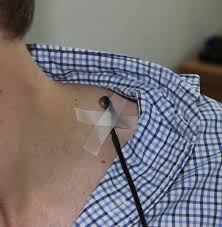
Tactile DRT (TDRT)
A small vibrating motor placed on the participant's shoulder or collar. The tactile stimulus avoids interference with visual tasks, making it ideal for evaluating displays and touchscreens.
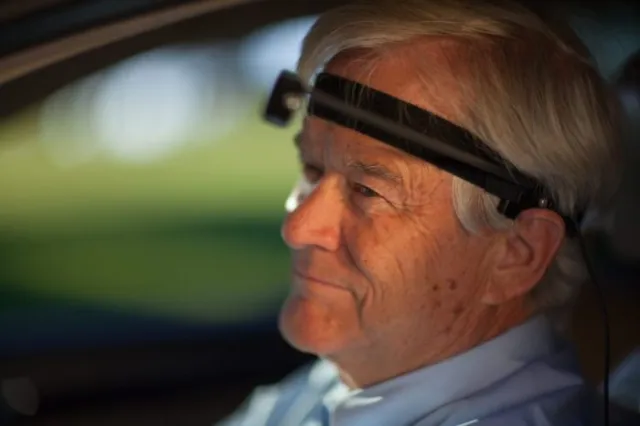
Head-Mounted DRT (HDRT)
A red LED mounted to a lightweight headband, positioned in the participant's peripheral vision. The visual stimulus moves with the head, maintaining a consistent visual angle.
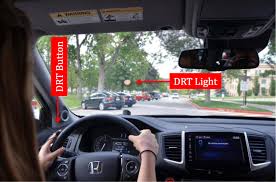
Remote DRT (RDRT)
A fixed LED positioned in the peripheral visual field, typically mounted on the dashboard or A-pillar. Also known as the Peripheral Detection Task (PDT).
Standards Compliance
ISO 17488:2016
International standard defining DRT methodology for assessing attentional effects of cognitive load in driving. Specifies apparatus, procedures, timing parameters, and metrics.
Research Validated
The DRT has been extensively validated in peer-reviewed research as a sensitive measure of cognitive workload that correlates with driving performance decrements.
Software Integration
Our DRT hardware integrates seamlessly with RSLogger, our cross-platform data acquisition software. RSLogger's DRT module provides:
- ISO 17488 compliance — Configurable stimulus intervals (default 3-5s random), response windows, and timing parameters
- Real-time monitoring — Live response time graphs, hit rates, and miss tracking during sessions
- Multi-device synchronization — Synchronize DRT with cameras, eye trackers, GPS, and other modules using unified timestamps
- Automatic data export — CSV files with stimulus times, response times, and calculated metrics
References
- ISO. (2016). ISO 17488:2016 Road vehicles — Transport information and control systems — Detection-response task (DRT) for assessing attentional effects of cognitive load in driving. International Organization for Standardization.
- NHTSA. (2014). Detection Response Task (DRT) Evaluation for Driver Distraction Measurement Application. DOT HS 812 077. National Highway Traffic Safety Administration.
- SAE International. (2015). SAE J2944: Operational Definitions of Driving Performance Measures and Statistics.
- Engström, J., Markkula, G., Victor, T., & Merat, N. (2017). Effects of cognitive load on driving performance: The cognitive control hypothesis. Human Factors, 59(5), 734-764.
Get Started
Ready to measure cognitive load in your research? Contact us to discuss which DRT configuration is right for your application.
Set Up Your Device
Already have the hardware? Get up and running with the configuration guide and download the latest RSLogger software.