
Overview
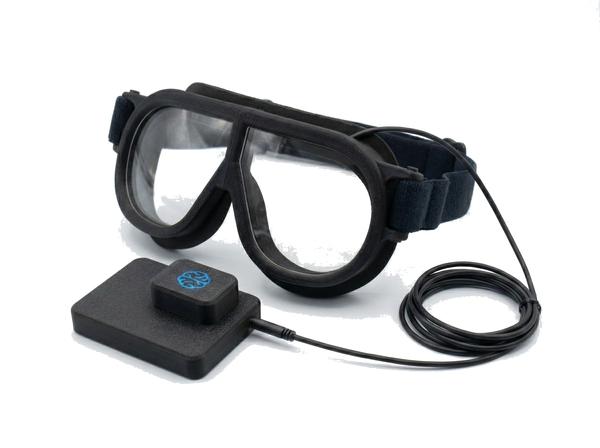
The Red Scientific Visual Occlusion Goggles implement the occlusion method defined in ISO 16673:2017 and the NHTSA Driver Distraction Guidelines. Electronically controlled liquid crystal lenses alternate between transparent and opaque states, measuring how much visual attention in-vehicle tasks require. The goggles connect via USB to a controller box that integrates with our RSLogger software for synchronized data collection.
Used for NHTSA compliance testing, in-vehicle HMI development, touchscreen and display assessment, voice interface studies, and academic human factors research.
How It Works
During testing, the goggles alternate between opaque and transparent states at precise intervals. Participants perform in-vehicle tasks while vision is periodically blocked:
- Total Shutter Open Time (TSOT) — Sum of open intervals needed to complete the task
- Total Task Time (TTT) — Total time from task start to completion
- Resumability (R) — How well users resume tasks after each interruption
NHTSA guidelines specify that tasks should be completable within 12 seconds of cumulative glance time.
Test Procedure
The ISO 16673 occlusion method uses timed intervals to simulate driver glances:
Lenses become transparent. Participant views the interface and continues their task.
Lenses become opaque. Vision is blocked, simulating eyes-on-road time.
Cycle continues until task completion. Total Task Time sums all open intervals.
Standards Compliance
ISO 16673:2017
International standard for the occlusion method to assess visual demand due to the use of in-vehicle systems. Defines test apparatus, procedures, and metrics.
NHTSA Guidelines
The U.S. National Highway Traffic Safety Administration's Visual-Manual Driver Distraction Guidelines use occlusion testing as a key acceptance criterion.
Software Integration
Our Visual Occlusion Goggles integrate seamlessly with RSLogger, our cross-platform data acquisition software. RSLogger's VOG module provides:
- ISO 16673 compliance — Configurable open/closed intervals (default 1.5s each) and timing parameters
- Task event tracking — Mark task start and completion with keyboard shortcuts for automatic TSOT calculation
- Multi-device synchronization — Synchronize VOG with cameras, eye trackers, GPS, and other modules using unified timestamps
- Automatic metrics — CSV files with Total Shutter Open Time, Total Task Time, and state transitions
Why Choose Red Scientific
When comparing visual occlusion solutions for your research, Red Scientific offers distinct advantages over traditional options like PLATO spectacles:
Integrated Software
Our RSLogger software provides automatic ISO 16673 metrics calculation, eliminating manual data processing. Export synchronized CSV files with TSOT, TTT, and state transitions.
Multi-Device Sync
Synchronize occlusion data with cameras, eye trackers, GPS, DRT, and audio using unified timestamps. Build complete research datasets in a single session.
Cross-Platform Support
Run on Windows, macOS, Linux, or Raspberry Pi. Deploy in the lab or in-vehicle with portable hardware configurations.
USB Connectivity
Simple USB connection to our controller box. No complex TTL wiring or separate power supplies required for basic operation.
Frequently Asked Questions
What is the difference between Red Scientific Visual Occlusion Goggles and PLATO glasses?
Red Scientific Visual Occlusion Goggles offer several advantages: USB connectivity for easy integration, cross-platform RSLogger software included, automatic ISO 16673 metrics calculation, multi-device synchronization with cameras and eye trackers, and modern design with configurable timing parameters. Both use liquid crystal technology, but Red Scientific provides a complete integrated research solution rather than standalone hardware.
Are the goggles ISO 16673 compliant?
Yes, Red Scientific Visual Occlusion Goggles fully comply with ISO 16673:2017, the international standard for the occlusion method to assess visual demand. They also meet NHTSA Visual-Manual Driver Distraction Guidelines requirements for automotive HMI testing.
What metrics do the Visual Occlusion Goggles measure?
The goggles measure Total Shutter Open Time (TSOT), Total Task Time (TTT), and Resumability (R). NHTSA guidelines specify that tasks should be completable within 12 seconds of cumulative glance time. Our RSLogger software calculates these metrics automatically.
What software is included with the Visual Occlusion Goggles?
The goggles include RSLogger, a cross-platform data acquisition software available for Windows, macOS, Linux, and Raspberry Pi. RSLogger provides ISO 16673 compliant timing, automatic metrics calculation, and synchronization with cameras, eye trackers, GPS, DRT systems, and other research devices.
Can I use the goggles for NHTSA compliance testing?
Absolutely. The Visual Occlusion Goggles are designed specifically for NHTSA Visual-Manual Driver Distraction Guidelines compliance testing. Many automotive OEMs and suppliers use our goggles for HMI evaluation and certification.
References
- ISO. (2017). ISO 16673:2017 Road vehicles — Ergonomic aspects of transport information and control systems — Occlusion method to assess visual demand due to the use of in-vehicle systems. International Organization for Standardization.
- NHTSA. (2013). Visual-Manual NHTSA Driver Distraction Guidelines for In-Vehicle Electronic Devices. 78 FR 24817. National Highway Traffic Safety Administration.
- JAMA. (2004). Guidelines for In-vehicle Display Systems — Version 3.0. Japan Automobile Manufacturers Association.
- SAE International. (2015). SAE J2364: Navigation and Route Guidance Function Accessibility While Driving.
- Alliance of Automobile Manufacturers. (2006). Statement of Principles, Criteria and Verification Procedures on Driver Interactions with Advanced In-Vehicle Information and Communication Systems.
Get Started
Interested in using visual occlusion goggles for your research? Contact us to discuss your requirements and get a quote.